|
|
 |
|
A WebService contains two sides: Client and server. In
general a WebService is a synchronous data exchange service
of two points connected via a network. This means after a
short time (less than the http timeout, which normally is 300
seconds) an answer of the WebService server is required.
Bioinformatic programs run usually much longer than five
minutes. To avoid problems with timeouts, one could use a
technique called Request and reply with polling.
|
| |
|
|
| |
|
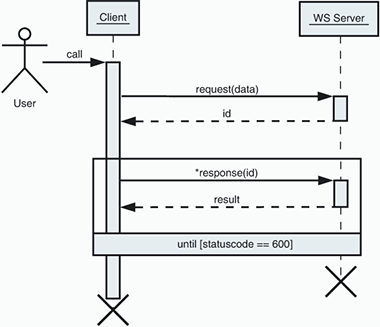
The client side submits a job with the
required data (program parameters and data etc.) and
immediately gets an id after the job was started which
normally takes some seconds (name convention request).
Afterwards the client side is able to ask for the result using
this id. If the computation of the program is not finished, the
client side gets back a statuscode with an enhanced description.
|
| |
|
These statuscodes and their descriptions are defined by
HOBIT to reach interoperability between WebServices, which
use these statuscodes. They will be represented within the
detail part of a SOAP Fault Message according to a HOBIT specified
XML Schema called hobitStatuscode. This can easily
be evaluated.
This polling technique completely avoids problems with
timeouts. The client side can even request the results hours or
days later or from another host, just with knowledge of the
id.
|
| |
|
id = webservice.request(input-data) #submit and get an id.
while (true) { #poll until result
  result = webservice.resposne(id) #poll
  if (!result) { #if NOT finished
   eval_statuscode # check for current status
  } else { #if ready
	break #ready !
  }
  wait 5 #wait short time
}
process(result)
|
|
|